Dbs101_unit6_lesson14
Unit VI: Indexing and Query Processing
Lesson 14: Indexing and Trees in SQL 🧭
Introduction
Welcome back, data adventurers! 🌟 In this blog, we unravel the magic behind SQL indexing, multilevel strategies, and the mighty B-tree family. Whether you’re querying data like a pro or still figuring out what a “hash index” is, this lesson will give you the boost you need. Let’s go from basics to brilliance! 🚀
What Are Indexes? 📖
Indexes are like the table of contents in a book—they help the database find what it’s looking for fast. Without them, the database would have to flip through every page to find a word.
- Definition: Special lookup tables that help speed up data retrieval.
- Without Indexes? Painful! Queries would read entire tables even for a single student record. 😓
Types of Indices 🗂️
1. Ordered Indices (Sorted & Ready!)
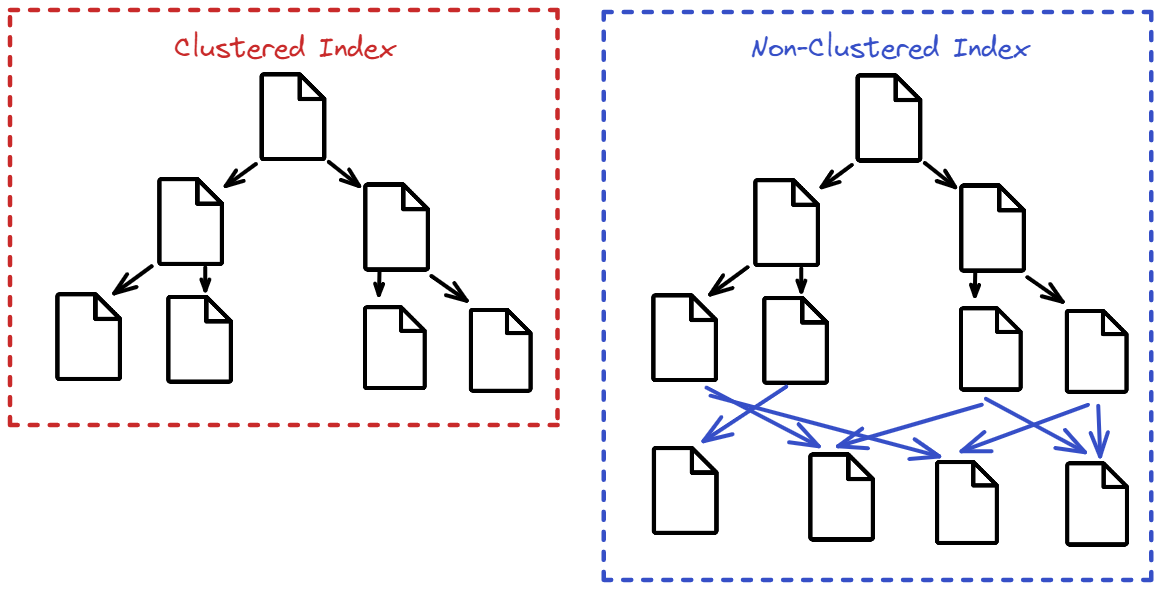
- Clustering Index: Records are stored in the same order as index entries.
- Non-clustering Index: Records are stored in a different order than index entries.
2. Hashed Indices (Buckets of Speed!)
- Hashing: Spreads values across buckets using a hash function.
- Search Key: Attribute(s) used to look up data.
Ordered Indices in Detail 🔍
Clustering Index:
- Entries match the sort order of the data.
- Pointers link to the first record of the matching key.
Non-Clustering Index:
- Entries may not match data order.
- Pointers link to all records matching the key.
Dense vs Sparse Index
Dense Index:
- Indexes every search key.
1
CREATE INDEX employees_idx ON employees (emp_id);
Dense Non-Clustering Index:
1
CREATE INDEX employees_dept_idx ON employees (department);
Sparse Index:
- Indexes some search keys.
1
CREATE INDEX employees_sparse_idx ON employees (salary) WITH (fillfactor=100);
🔍 Use EXPLAIN ANALYZE to see index performance:
1
EXPLAIN ANALYZE SELECT * FROM employees WHERE emp_id = 12345;
Multilevel Indexing 🎯
Why Multilevel?
When indexes grow too large for memory, searching becomes slower. Enter multilevel indexing!
- Inner Index (on disk)
- Outer Index (smaller & in-memory)
🔁 Process:
- Search outer index (fast)
- Narrow down & search inner index (efficient)
Secondary Indices 🔄
- Created on non-primary key columns.
- Helps in sorting/searching beyond the primary key.
👉 Example use case: Searching employees by department rather than emp_id.
Meet the B-Tree Family 🌳
B+ Tree
- Self-balancing, ordered.
- Keeps data in leaf nodes only.
- Inner nodes only guide the search.
1
2
-- Example Search Process:
-- Start at root → move right if key > value → continue until leaf is reached.
B Tree
- General form of search tree (unlike BST, stores multiple keys per node).
- Nodes have:
- Between ⌈n/2⌉ and n children.
- Balanced height for optimized performance.
Why B-Trees? 🔐
- Reduced height = faster access.
- More keys per node = fewer disk reads.
- Used heavily for databases and file systems.
Properties
- Ordered keys.
- Equal leaf depth.
- Root has ≥ 2 children.
- Balanced height via rules:
- Left/right subtrees balanced.
- Max height diff = 1.
B-Tree vs. B+ Tree 🥊
| Feature | B Tree | B+ Tree |
|---|---|---|
| Keys Stored In | All Nodes | Leaf Nodes |
| Internal Nodes | Keys + Data | Only Keys |
| Leaf Access | Slower | Faster |
Hash Indices 🧮
When equality searches matter (not range queries), hashing is king.
1
2
3
4
5
6
7
8
9
10
11
CREATE TABLE users (id SERIAL PRIMARY KEY, name TEXT);
CREATE INDEX ON users USING hash (id);

-- Insert
INSERT INTO users (name) VALUES ('Alice'), ('Bob');

-- Lookup
SELECT * FROM users WHERE id = 2;

-- Delete
DELETE FROM users WHERE id = 2;
Hash Buckets
- Data distributed using a hash function.
- Overflow handled via chaining.
- Not suitable for range queries.
Static vs Dynamic Hashing 🧊🔥
- Static: Fixed buckets. Needs rebuild if overflow.
- Dynamic: Buckets grow incrementally (e.g., linear hashing).
1
REINDEX INDEX users_pkey;
What I’ve Learned & Why It Matters 🧠
- Indexing is vital for performance—think of it as memory for your database.
- Multilevel indexing helps when data gets massive.
- B+ trees are the unsung heroes behind efficient searches.
Personal Growth & Reflection 🌱
- Initially, “index” felt like a textbook term. Now, I see it as a performance booster!
- Understanding B+ trees gave me confidence to approach real-world SQL problems.
- Learning to balance between hashing and indexing strategies helped me become a smarter data thinker.
Fun Tips to Remember 🎉
- Dense = every record, Sparse = selective records.
- B+ Trees = like directories at malls — guide you to exact stores!
- Hashing is fast for exact matches, not for “find all under $500”.
- Always use
EXPLAIN ANALYZEto validate performance.
Conclusion
Indexing turns chaos into order in the database world. From clustering to hashing to B+ trees, these tools transform your SQL into something both powerful and elegant. Keep exploring, keep querying, and remember—your next SELECT might just fly thanks to a clever index! 🛫